Pacing Yourself


I've found a common theme in my first 4 years of teaching is mid-semester burnout. I get a point where I'm just ready for that semester to be done so I can start fresh. My first semester my first year, this moment occurred six weeks into the year.

I remember that I would do this as a student as well. I would start a semester with these lofty visions of actually reading everything the teacher assigned* and actually paying attention in all of my classes. Inevitably, I would reach a point in the semester where I would get tired or busy or overwhelmed or distracted or something. I would switch into a survival mode where I did the required work but no more. I figured out where I needed to be to earn my points and I would get right there on that line, but no further.

*A good reminder for myself that I did this, so I shouldn't think my students are terrible people when they don't read their homework. They're just teenagers.

There are several things to take away from this little bit of reflection:

1. Do my assignments really matter? If a student does not complete a particular assignment, will they or I feel like they've really missed something? I remember my first year teaching a student missed a day. She came to me when she got back and asked what she missed. I told her we did a worksheet, but it wasn't that important and to not worry about making it up. I thought about that story earlier this year while giving a student a detailed breakdown of the work they had missed and shook my head at myself.

I wish I could tell that small story wasn't true. Getting past this challenge is harder than you would think, but it's a good habit to come back to the question regularly when planning work for the students. I regularly remind myself to assign less work that more meaningful rather than more work that is less meaningful.

2. Does my class have a flow, or is it full steam ahead at all times? I think part of what led to my burnout each semester was that there were very few natural breaks. I'm not saying that there should be weeks where there should be no work, but I do think it is good habit to think about the stress that I am putting on students at any given time.If my goal in class is to foster thought and reflection, I need to create an environment where that can take place.

I have started giving vocabulary work each Monday. This looks like pretty quiet individual work as the students complete their weekly vocabulary. On Friday, they take a short quiz and then they write a journal over our essential question for the week. The simple fact that there is more of a routine to my week has helped both mine and my students stress level. I asked my students in a survey after 3 weeks "Does the weekly vocabulary help you learn better throughout the rest of the week?" A shocking 94% of my students answered this question with a 'yes'.

My fantastic wife Angela (@autismteacher13) teaches a classroom for kids with autism. Their entire schedule is based on building and maintaining routine. Routine is important for all kids. Routine helps kids feel comfortable. Routine can free a student's mind from worrying about what the hell is going on in class so that he can think about why inequality exists in our world.

3. Do students see the skills they learn in class revisited? I realized last year that most of my students cannot accurately make a timeline unless their given an unrealistic amount of guidance. So this semester, we used a timeline as the method for learning about the French Revolution. We made two full timelines. The second was more complex than the first. I was able to teach specific skills relating to timeline building in-between each formative assessment and see those skills grow. The plan is to do the same thing during my current unit with the Revolution except with maps. The skill of reading or creating a map isn't the content, but knowing that each Tuesday we're going to layer on* to map-reading this unit provides structure that eases the minds of the students. While this may seem like basic stuff, it's not really taught in teacher education classes - or at least the one's that I took.

*Three cheers for scaffolding! It actually works! 

This is also a great way to build assessments into your unit that are not multiple choice tests. In this unit on the Industrial Revolution, the students' summative assessment will be to design a small town from scratch. This will test their knowledge of what parts of a city are most important - do they include a trash dump before they include a hair salon? It will test their basic knowledge of the important aspects of a map. It will also provide a different kind of assessment to help those students who absolutely freak when they are given a test.

4. Am I building a model that I can sustain my entire career? Listen, I'm a 27 year-old teacher married to another teacher who understands the need for working in the evenings and on the weekends. She does the same. But we have our first kiddo coming in May, and that has me thinking about what my class will look like for the rest of my life. Can I do what I'm doing now with a baby? With a teenager? I've begun to think more about the time constraints that I will have once it is not just two work-a-holics living alone like my wife and I are now. I can reuse the lists of vocabulary words and their corresponding quizzes year after year. I am able to grade 3rd hour's vocabulary sheets as 4th hour is completing theirs. The weekly quiz is online and grades automatically. My Moodle online classroom will preserve the bulk of what I do year-in and year-out when I teach and reteach curriculum. There will surely be tweaking, new lessons and projects. But I have started to plan with my future a bit more in mind so that I can be a great teacher next year and in ten years.

***

Thanks for reading this blog. I hope you'll consider taking a moment to comment below and turn this into a conversation. Whether you are an educator or not, we have all had common experiences with education both good and bad. I want to hear what you think! 

Follow me on Twitter! 

Teaching is an Art

Teaching is as much an art as it is a science. Let me give you an example:

I have recently come to the realization that I had been a very poor teacher of vocabulary for the first 4 years of my career. I made that a goal at the start of this school year to become better at this. For the first semester - nothing big. Over winter break, I started writing a list of the vocabulary words kids would need to know for the next unit on the French Revolution.

The first light bulb moment was realizing just how many words made it on my list that were not in bold in the book. I call this a light bulb moment because I knew the problem existed before. Hart and Risley came out with a study in 1995 that showed that children in affluent homes hear 382 words per hour while children from low socio-economic homes hear 167 words per hour. (You can read about the issue more here. Hart and Risley were one of many studies on the issue.) If I knew the issue existed, then why could I not figure out a better solution?

What I decided to do this current semester was to make vocabulary the central pillar of my teaching. Each Monday, I would give a new set of vocabulary terms. The students were given quiet work time to define those terms and it was done. Through the week, I would make a point to reference a vocabulary word any chance I got. And each Friday, I would give a quick, silent, but difficult vocabulary quiz. The catch was that the kids could use their vocabulary pages - this gave them encouragement to prepare for the quiz and took the emphasis off of pure memorization.

After the third week of the semester, I decided it was time to collect some data. I asked three simple questions (view the whole survey here), the third being "Does the vocabulary list each Monday help you understand things better in class?" Of the 86 kids who took the survey, 80 of them responded yes. There is no doubt in my mind that a large part of being a teacher is taking the time and effort to study pedagogical theory and practice and collect data on what does and does not work. Teaching is certainly a science.

But it is not all science.

Last week I had a student come up to me and tell me a heart-breaking story of her life at home the past week. Without sharing any of her details, her life had turned into a mini-hell for reasons that had nothing to do with her or her life choices. She was caught up in a whirlwind and was just riding out the storm. We talked for a while about what was going on and I asked her what I could do to help - unfortunately, not much. I gave her a hug and told her that she shouldn't worry about any due dates for a bit. We would work together to keep her caught up from the days she had missed. I told her that she had built up great trust with me over the year and that sometimes school isn't the most important thing. I told her that sometimes we're asked to be adults earlier than we want.

All the vocabulary acquisition and strategy building in the world doesn't help me to handle that situation. In my several years of teacher education, no one ever talked about dealing with this aspect of teaching, yet it is without a doubt in my mind the most important aspect of my job. I think the problem with high-standards testing, at its core, is that it only measures the science of teaching and not the art of it. I don't know what test does measure the art of teaching or if that test could possibly even exist.

 This past weekend, I attended something called an #edcamp conference in St. Louis. In my fourth session of the day, a group of us were talking about academic and personal interventions for students who are starting to fall behind. One of the other teachers pointed out that the flaw in our conversation was that no system or program would ever fix every problem. There are a thousand and one different students without a thousand and one different issues. We can only get to know our kids, love them and do our best to predict what will help them with the next steps in their lives.


There are many quality conferences out there, but I'm not sure any of them get at the art of teaching quite like an #edcamp.

If you teach and have never been to an #edcamp, you need to find one and go. If you're in Kansas City, #edcampLiberty is coming up on March 7th and a big group from Center will be there. If you don't teach and want to understand teaching better, go to #edcampLiberty and just talk to some teachers. That, by the way, is the coolest part of #edcamp - there's a schedule, but if you get caught up in a conversation and it's great, you're encouraged to skip sessions, grab a cup of coffee, and keep up the conversation.

PICTURES - We The People

We The People is such a drawn out experience in many ways. I took the first step towards prepping for this during the summer last year. The students took their first steps starting around October. And yet the competition itself lasts about 45 minutes. Here we are, about 20 hours after arriving in Jefferson City, and we back on the bus headed back to KC. I'm far too tired to put anything coherent together in a blog post at the moment, so I'll save that for later.

I wrote a separate post on the behind-the-scenes of this competition on the bus ride to Jefferson City yesterday. If you haven't read that yet, check it out here.

For now, here are some pictures of our trip. More to come later as I get some feedback from the students and a full night or two of sleep.

High School kids sleep in the most
incredible postitions!


Catching some pool time at the hotel
Center took 8 students to Jefferson City to compete

Team dinner at Arris Pizzeria in downtown
Jefferson City after a walking tour of
the Capitol

Students put in about 3 hours of prep work
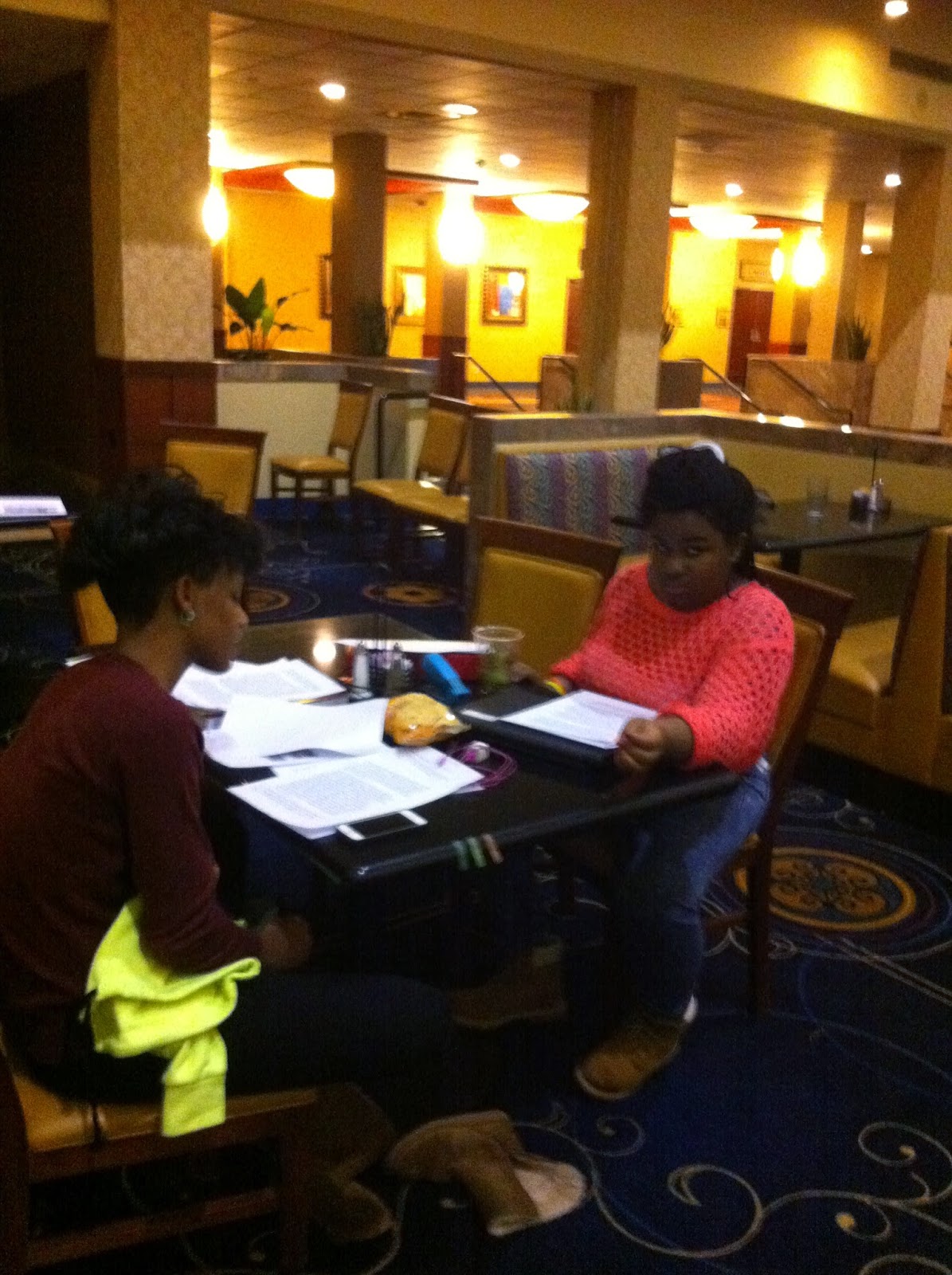
on Sunday evening at the hotel

This competition requires deep knowledge
of the US Constitution, speaking skills and
collaboration in small groups

Students prepare for their presentation in one of the
Missouri State Capitol Hearing Rooms


From left to right:
Monae Norton, Daleshawn Smith, Malik Johnson, Nick Hoof, Chyna Scott,
Taylor Johnson, Allan Medina, Jaun Lobo, Alec Chambers (teacher)
Not pictured: Troy Butler (Asst. Principal - he took the picture)