Getting Over The Hump

I love hump day.


Coming back to educational thought, shouting hump day down the hall to students* got me thinking today about why the hell it's so hard to get over the educational technology hump. The incredible Collen McLain (@colleenmclain) was in my room today troubleshooting an issue with Moodle and I asked her how the whole 1:1 technology initiative was going building-wide. We just finished our 12th day of classes and I was curious how our school as a whole was adjusting to the change.

*I tend to do this many Wednesdays...don't judge me.

The interaction was really interesting. She told me that she had not heard much, and that in her mind no news was good news. I responded that no news might also mean that teachers who weren't comfortable with the technology to begin with were hesitant to try new things, which would in turn lead to e-mails and pleas for help to Colleen. I don't know which one it is. I'm hopeful it's her answer but suspect it might be mine.

There are several teachers that I've been working with who are jumping out of their comfort zone with technology. One of our spanish teachers is tackling Moodle with great zeal, has hit a few bumps, but seems to be moving along steadily. I worked with an english teacher this morning on downloading YouTube videos and uploading them back to Google Drive - something I had actually never tried before but figured out with her. Another social studies teacher has been dropping by my room periodically in the morning to ask questions about Moodle, which has pushed me to make some tutorials you can check out here.

There is certainly learning going on throughout our school, but I suspect there is also a great deal of hesitancy. Heck, I fight as hard as anyone at my school for technology to be unleashed and I'm still nervous about trying a new tool on Moodle or a new website that's been suggested to me. The hesitancy itself isn't bad at all. The reason for the hesitancy is worth some conversation. I hope if you're reading this you'll consider sharing your point of view below in the comments. Hearing others stories is really powerful.

Why is it so hard to get over the hump?

I should leave this to the psychology teachers out there, but oh well. I think back to my first two years of teaching when I regularly began classes at the start of the day with a vague idea of what I wanted to happen but very little direction. I think about the boredom I saw on the faces of the students. I think about the plans I had in my head and on paper that crashed and burned as if being chased by the Red Baron himself. I think about my emotions. I often try to get my kids to think about the emotions of the people we study in history and government.

What did it feel like to hear that people were being beheaded regularly during the French Revolution?

What would it feel like to hear shattering glass as you hide in your home during kristalnacht?

Why is it so easy to ignore the 900 things that went wrong in the hours, days, years and generations leading up to the shooting of Michael Brown in Ferguson, MO? Can you put yourself in the shoes of whatever race you are not and then think about what happened? 

I think back to the emotion of those first years of teaching. I think about the fear that I felt knowing that what I had planned wasn't good enough; knowing that I was not yet an expert in the content that I was teaching; knowing that my ability to scaffold a concept was far from masterful; knowing that this group of students was being taught by a less-complete version of me than is teaching today.

These thoughts can do a lot of things, but I think the worst thing they can do is they can cause me to freeze. If I let these thoughts take over my mind, then I can slip into a space where all I want to do in class is that with which I am extremely comfortable. I know it may not be life-changing or world-shattering, but I know it won't suck either. When it comes down to it, this is why we freeze up when fear and anxiety take over.

And that is the scary part of technology for many of us in the educational world. For those of you who aren't teachers, think about this for a moment:

I teach 6 separate classes on two different subject. That's a a total of 5 hours of true teaching, presenting and all that other things that teachers do each day. To get prepped for those 5 hours, I get 50 minutes. Rinse and repeat day after day for 175.

The prep time that teachers get compared to the time that we are 'on-stage' is ridiculous! Think of a business leader conducting a workshop or presenting EVERY DAY and only getting a little time each morning to adjust and reshape this ongoing presentation. It wouldn't happen! The ratio of prep-time to presentation-time is way out of wack in education.

So when I have something new I want to try, I don't have the time to thoroughly prep, plan and organize this new idea before I put it out there in front of over 100 teenagers. When I think about this with a piece of technology with which I am unfamiliar, the world starts to shrink, I start to sweat and I retreat to cuddling with my cat for safety. You can't think about teaching like this, even though it's the reality.

The Shift...

Here's the shift in thinking that I have learned to accept and that I propose to other educators. We must think of the 'show-time' in class not as show time, but as collaboration time. This is nothing new in education pedagogy, but applying it to our use of technology can be really powerful. My wife, a fantastic educator of children with autism, just gave me this quote that encompasses everything that encourages me to jump over the hump, regardless of what is on the other side of the hill:


"The best teachers are those who show you where to look but don't tell you what to see." 
-Alexandra T. Trenfor

There's the important part. I have knowledge about historical facts and I have knowledge about important skills. I also now have a tool (our laptops) that opens up a ridiculous amount of new places to look and new strategies for looking. And that's my job - to encourage looking without telling the kids what they will find and what they should feel about what they find.

I have talked with my classes a lot this year about process. I tell them that I am going to make a lot of mistakes throughout the year, as are they. I am going to try a lot of new ideas, new websites, new tools and new teaching strategies. The flip side of this is that I need their help and communication in letting me know when something works and when something sucks!

By doing this, something really cool has happened - when I ask how a particular idea worked, I tend to get really honest feedback AND a lot of buy-in as far as student effort goes. I certainly get told when things are boring and lame and suck (and some of them, like reading and writing and presenting, still occur often in class) but I am also told when things are great and when kids really enjoy class. I have heard positivity about class so much more in the first three weeks of this year and I'm convinced that my communication about the process is the reason why.

Changing your thinking about class a process rather than a moment of presentation can make 'the hump' much less intimidating. It raises your vision to a higher level so that you can see 'the hump' as part of a larger journey rather than a single, frustrating obstacle.

How have you gotten over 'the hump' in the past? Share below in the comments section!

Love it? Hate it? Leave your thoughts below and let's talk about it!
Get in touch! 

E-mail: alectchambers@gmail.com            Facebook                        Twitter: @chambersalec

When The World Doesn't Work

A quick post this week as we are in the middle of the first full week of implementing our new 1:1 technology initiative here at Center. As a teacher and professional, I like knowing what is going to happen. I think that this is a big chunk of the fear and nerve that teachers have when it comes to putting technology in the classroom.

Will it work?

Will the internet be fast enough?

Will the website I found be blocked?

Will I look like an idiot?

Our students got their laptops last Thursday. They were required to come to Back to School Night, watch a 12-minute video about online etiquette and school policies and sign a liability waiver. Based on the normal attendance at Back to School and Parent-Teacher Conferences, I was not confident that kids and parents would show up. But show up they did, and in droves! If there was any doubt about the buy-in of the community, Back to School night erased it for me.

So that was Thursday night. Friday I had the kids participate in the Marshmallow Challenge (see the TED talk below) to build some community feel. The Marshmallow Challenge really is a great start to any group that could use some lessons on teamwork and collaboration. You should try it out with your class or business group.


Go-Time...

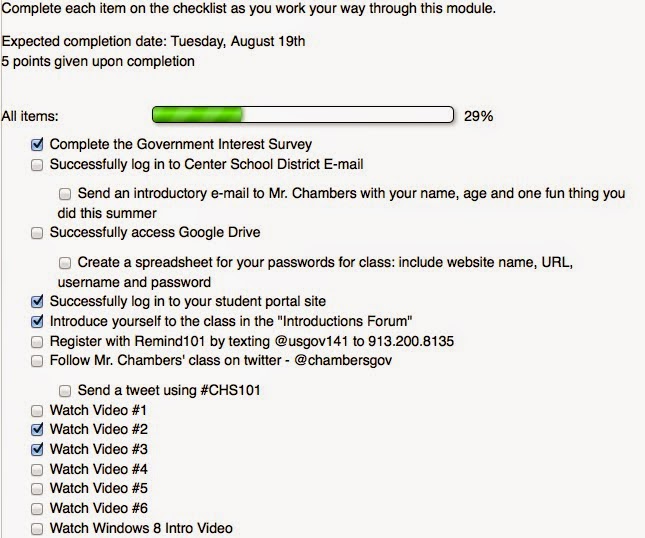
Monday was the day to get the laptops rolling, enroll my kids in their Moodle course, get them going on Google Drive, have them follow our class on Twitter and get them signed up for Remind 101. I had planned 2-3 days to troubleshoot all of this, all guided by a checklist on Moodle for the kids to follow as well as some online tutorials. Two of the six videos I made are at the bottom of this post if you want to check them out.*

I use checklists on Moodle to help students know what tasks
they need to complete within a unit or a module
*I've also started making a tutorial series for teachers who are trying to get Moodle going. Hopefully it can be useful for you or someone you know who is a bit intimidated by Moodle. Check it out here.

So we get to Monday morning. I have Moodle ready to go with the aforementioned video tutorials, checklists, sample Google Docs and all the other great stuff I had been prepping. The kids walk in and I give them a big smile and a handshake. I welcome them and tell them this is going to be a day to remember.* I remind them that the computer is a tool to get them to think, not a virtual note-taker-thingy. I remind them that this is what college is like. I remind them that I'm open to just about anything new with educational technology and to let me know when things work and when things don't. I remind them that this is going to be flippin' awesome!

*Or a day possibly to forget, as it turns out!

I then invite them to power up their laptops, log into Moodle and start working their way through their first checklist. I tell them my role is to help them when they get stuck, but they need to problem solve as much as they can. When all of this is said and done and I've done all I can to get ready (notice the I-statements in the last paragraph...teachers have a lot of prep-work in a situation like this), it's now finally time to see what the students will do. I'm excited. I'm nervous. I'm anxious. I'm (fill-in-the-blank adjective) and ready to go!

The internet doesn''t work.

Teachers, and I assume the rest of the world, are big on first impressions. The first time I jump into something, I want it to go perfectly. When it does, I feel like I build up a trust with my kids that when I tell them something is going to be this or that, it's really going to be that way. We had all told the kids that this laptop roll out would have it's kinks and mess-ups, but none of us figured that the first mess up would be the internet!

So what happens next? I decided to make two goals out of the day in which all of my learning goals required the internet. The first was to talk about communication. When each class had their 15 or 20 minutes of trying things out, I stopped them for a minute and asked what was going right and what was going wrong. I worked them through the current situation as an analogy for their school year. Their laptops were messing up. The internet was not working right. Moodle, if they could get it to work, was going terribly slow. Similar things might happen to them between this day and the end of May, and if they don't let teachers or friends or parents know, we can't help! I was sending 2 - 4 e-mails per class hour to the technology department updating them on what was working and what wasn't. The classes knew I was sending these. Just like my e-mails, I encouraged them to communicate with me when something wasn't working. Otherwise, we won't be able to fix it together.

The second lesson I tried to pull out of this was perseverance. The third rule I have in my class* is to expect to succeed. It's vague, but we work through what it means throughout the year. Early on, I encourage the kids to think of this phrase in terms of perseverance. Those who expect failure give up as soon as it gets hard. Those who expect success enjoy that which is difficult and relish the challenge. Those who expect to fail have no idea about the end-goal of any of their actions. Those who expect success know the plan and have a clear vision for what will happen to see that plan through, even if there are some twists and turns along the way.

*I only have three...

I was so impressed, as I often am, with our group of kids. With very few exceptions, the kids kept restarting their laptops. They were helping each other troubleshoot. They were getting frustrated, but remaining composed and respectful. They tried to get to our Moodle classroom over and over and over again even when it became pretty clear that this particular issue* was going to last at least the entire day.

*It appears that the issue had to do with the router in my classroom which, for whatever reason, decided not to work on this day! Normally when a class router doesn't work, it looks for the closest router to piggy-back off of. This day, the closest router to my class wasn't working either! Center's truly incredible tech department has been working tirelessly for months I suspect, but we've seen them going in the flesh since teachers reported back last week. If you teach at Center or are there for any reason, including the football game this Friday, give one of them a hug if you see them!

So what do we do when our world doesn't work? What do we do when our plans fail miserably and blow up in our faces in spectacular fashion? I tend to believe that we remind students that they are living in the real-world, not a cool TV show or movie, and that this happens sometimes. Pick your analogy - making lemonade out of lemons, getting back up onto the horse - and make your classroom feel like a business meeting. They still have a goal. When things fail, let the kids help you diagnose the problem and brainstorm the solution. If your kids are like mine, they will amaze you with what they come up with.


May your world always work! And when it doesn't, may it you at least grow a little bit until it all starts spinning again!

Do you have a story of when your classroom plans completely bombed? Share it in the comments section below!

Below are those tutorial videos I promised earlier:

My video intro to the class!


 My video tutorial helping kids create a basic Google Spreadsheet

Love it? Hate it? Leave your thoughts below and let's talk about it!
Get in touch! 

E-mail: alectchambers@gmail.com            Facebook                        Twitter: @chambersalec

First Days of School

It is difficult to find words to describe the first year of teaching. The fear and anticipation of a class full of kids...a picture would do better at explaining what I wanted to do as day one approached:


The first day of the first year of school is at once on of the most memorable, exhilarating and miserable days of my life. Luckily, it only happens once. After that first year, my first day of school experience became something not worthy of fear but rather an opportunity. Just like I was so glad that the first day of my first year only existed once, I now regret that I only have one first day each year. I started to change my perspective after reading The First Days of School by Harry and Rosemary Wong; unfortunately I waited until my second year of teaching to read the book!

As a teacher at the high school level, my job is both to teach the content knowledge (History from the Italian Renaissance to modern times in one course and government civics in the other) and to teach skills. This is what Common Core wants educators to work for, although the system is flawed in all kinds of ways.*

* If we are to differentiate and personalize our teaching for each student as much as possible, why do we then judge students based on a single standardized test? Shouldn't student goals be based on improvement, not getting to a set goal no matter where an individual entered a grade?

Teaching skills and content knowledge requires us to change the way that we think about the structure of the classroom. Classroom pedagogy has been developing over the years away from a teacher-centered classroom towards a student-centered classroom. Technology, as well as the opening minds of administrators and teachers across the country, have helped push this change along. I am pretty stoked to be at a school that is implementing a 1-to-1 technology initiative with administrators that are generally excited and positive.

The first day of school allows me to set the tone for the entire year. Be honest and think back to your time in school. You could tell real quick how a class would be based on the habits of the teacher. Does my body language give away that I'm pissed that summer is over or do I show excitement when kids show up? Am I scrambling when the kids come in or am I calm and ready? Do I show fear or do I show confidence? Do students remember their first experience with me as their teacher? Do I make them think about an issue or question a belief? Are they challenged?

These are all questions that I try to consider throughout the year but they are intensely important on the first day. It is always easier to make class less rigorous, less disciplined, less thoughtful, less organized. The first day has to set a high standard in all of the categories just mentioned. I like to save the boring syllabus talk for a few days into the year. It's important, but it isn't a good first impression. My first day, I set up an argument and make kids take a stand. 

***
Good 'ol Socrates. Not to assume,
but I doubt he had a six pack...
A good argument is anything that can legitimately be argued from both sides, so there isn't a single one that works. I have two favorites, both of which are centered around the Socratic definition of utility and good. A lot of this is taken from my fantastic professor from William Jewell College, Dr. Gary Armstrong.

We start with a theory - everything has best purposes that makes it good. A screwdriver may be used to hammer in a nail, but that is not its best purpose. Screwing in screws is what a screwdriver is meant to do best. That and creating something new. These are the two goods of a screwdriver. Dr. Armstrong loves to use soldiers and argues that their ultimate good is to protect civilians and also to win battles. I like to use school. All of these have dual goods. A screwdriver that is used to screw in screws and murder someone cannot be good because it only fulfills one of the goods of a screwdriver. So the theory goes. 

Once I get students - usually one that I choose to pick on a little - to accept the premise of the theory, it's on to Socratic questioning.* I guide the students to define the good of school as learning knowledge and skills. Once they accept this first good, then we discuss if a student can be a good student if they only satisfy this one good. What is the second good of a student? I propose that it is to learn knowledge and gain skills and to get good grades. This addresses a key argument of many high schoolers - that the assignment may not be that important because they already learned the information.

*This is the first of many times throughout the year I will do this with my classes. The first time is a short day and by necessity is a bit more guided than the rest. I have a thought process I want them to achieve and only around 25 minutes to get them there. 

After their first 25 minutes in my class, I hope that I've achieved two goals. The first is convincing the kids that in my class, they will have to think critically and analyze different points of view. They will have to defend what they say and hear what others have to say as well. And yes - they will have to speak in front of the rest of the class. 

The second goal is to get the students to think a little bit about why they are here. This is good for the 11th grade Government class, but it is especially good for the 9th graders who are brand new to high school. They have a lot of decisions to make in the near future. I hope that this first day gets them on the right track both as a student in my class and as a person. I hope that they realize that grades, while not the end-all and be-all, are nonetheless still incredibly important. 

What does your first day of school look like? Share in the comments section below and we can discuss! Thanks for reading.

Love it? Hate it? Leave your thoughts below and let's talk about it!
Get in touch! 

E-mail: alectchambers@gmail.com            Facebook                        Twitter: @chambersalec